Architecture
Elassandra embeds OpenSearch inside Apache Cassandra so that each node participates in both the storage ring and the search cluster.
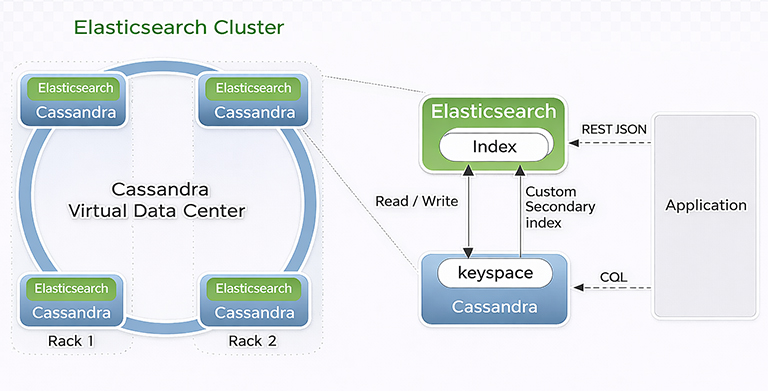
Concepts Mapping
OpenSearch |
Cassandra |
Description |
|---|---|---|
Cluster |
Datacenter group |
Nodes in the same datacenter group share search metadata. |
Shard |
Local token ranges |
Each node serves search for the data it stores locally. |
Index |
Keyspace |
An index is backed by a Cassandra keyspace. |
|
Table |
The current line uses the single |
Document |
Row |
Search documents are stored as Cassandra rows. |
Field |
Column or cell |
Indexed fields are backed by Cassandra columns. |
Nested/object field |
UDT or map |
Structured fields are mapped onto Cassandra composite types. |
From the OpenSearch point of view, Elassandra behaves like a distributed search engine. From the Cassandra point of view, Elassandra adds a secondary-index-backed search layer without moving source-of-truth data out of Cassandra tables.
Durability
Cassandra remains the durable storage layer:
writes are recorded in commit logs and memtables
flushes materialize SSTables and the corresponding search structures
restart and recovery replay Cassandra state and rebuild the local search view when needed
Because Cassandra owns replication and durability, Elassandra does not depend on a separate search translog for cluster-wide correctness.
Write path
When a document is written through the OpenSearch HTTP API or through CQL:
Elassandra translates the write into Cassandra mutations.
Cassandra stores the row using its normal write path.
The Elassandra secondary index updates the local search structures.
Cluster metadata updates are coordinated through Cassandra-backed metadata tables.
For search-first use cases, creating an index can also create the backing Cassandra schema automatically. For Cassandra-first use cases, Elassandra can discover an existing table schema and expose it as an OpenSearch mapping.
Search path
When a search request arrives:
The coordinator resolves the target indices and token ranges from Cassandra-backed metadata.
Requests are routed to nodes that own the relevant token ranges.
Each node executes the local OpenSearch query against its local search view.
Matching hits are resolved against Cassandra rows when field retrieval is needed.
The coordinator merges shard responses and returns a standard OpenSearch-style response.
This model keeps search close to the data and avoids a separate search-only storage tier.
Mapping and CQL schema management
Elassandra supports two complementary workflows:
OpenSearch-first: define an index or mapping and let Elassandra create the backing Cassandra keyspace, table, and secondary index objects.
Cassandra-first: create the keyspace and table yourself, then use mapping discovery so Elassandra exposes that schema through OpenSearch.
Schema and metadata changes are stored in Cassandra and propagated through the cluster, which keeps storage and search definitions aligned.